Sanitary Screens
Mesh Selection
| Space between wires | |||
| U.S. MESH | INCHES | MICRONS | MILLIMETERS |
| 4 | 0.1870 | 4760 | 4,760 |
| 6 | 0.1320 | 3360 | 3,360 |
| 8 | 0.0937 | 2380 | 2,380 |
| 10 | 0.0787 | 2000 | 2,000 |
| 12 | 0.0661 | 1680 | 1,680 |
| 14 | 0.0555 | 1410 | 1,410 |
| 16 | 0.0469 | 1190 | 1,190 |
| 20 | 0.0331 | 841 | 0,841 |
| 30 | 0.0232 | 595 | 0,595 |
| 40 | 0.0165 | 400 | 0,400 |
| 50 | 0.0117 | 297 | 0,297 |
| 60 | 0.0098 | 250 | 0,250 |
| 80 | 0.0070 | 177 | 0,177 |
| 100 | 0.0059 | 149 | 0,149 |
| 120 | 0.0049 | 125 | 0,125 |
| 140 | 0.0041 | 105 | 0,105 |
| 200 | 0.0029 | 74 | 0,074 |
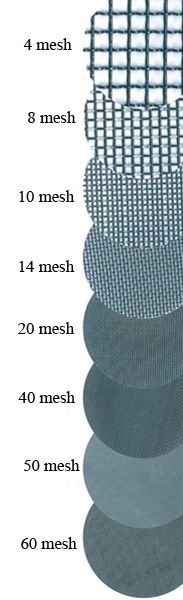
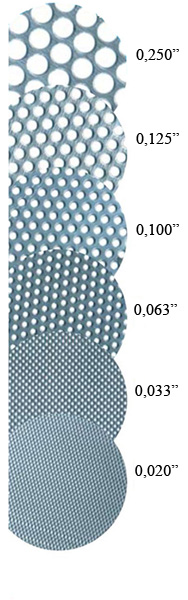






What does mesh size mean
Figuring out mesh sizes is simple. The number of openings in one inch of screen is the mesh size. So a 4 mesh screen means there are four little squares across one linear inch of screen. A 100 mesh screen has 100 openings, and so on. Note, therefore that as the number describing the mesh size increases, the particle size decreases.